
María Sabina, the woman who opened the doors of perception to the West
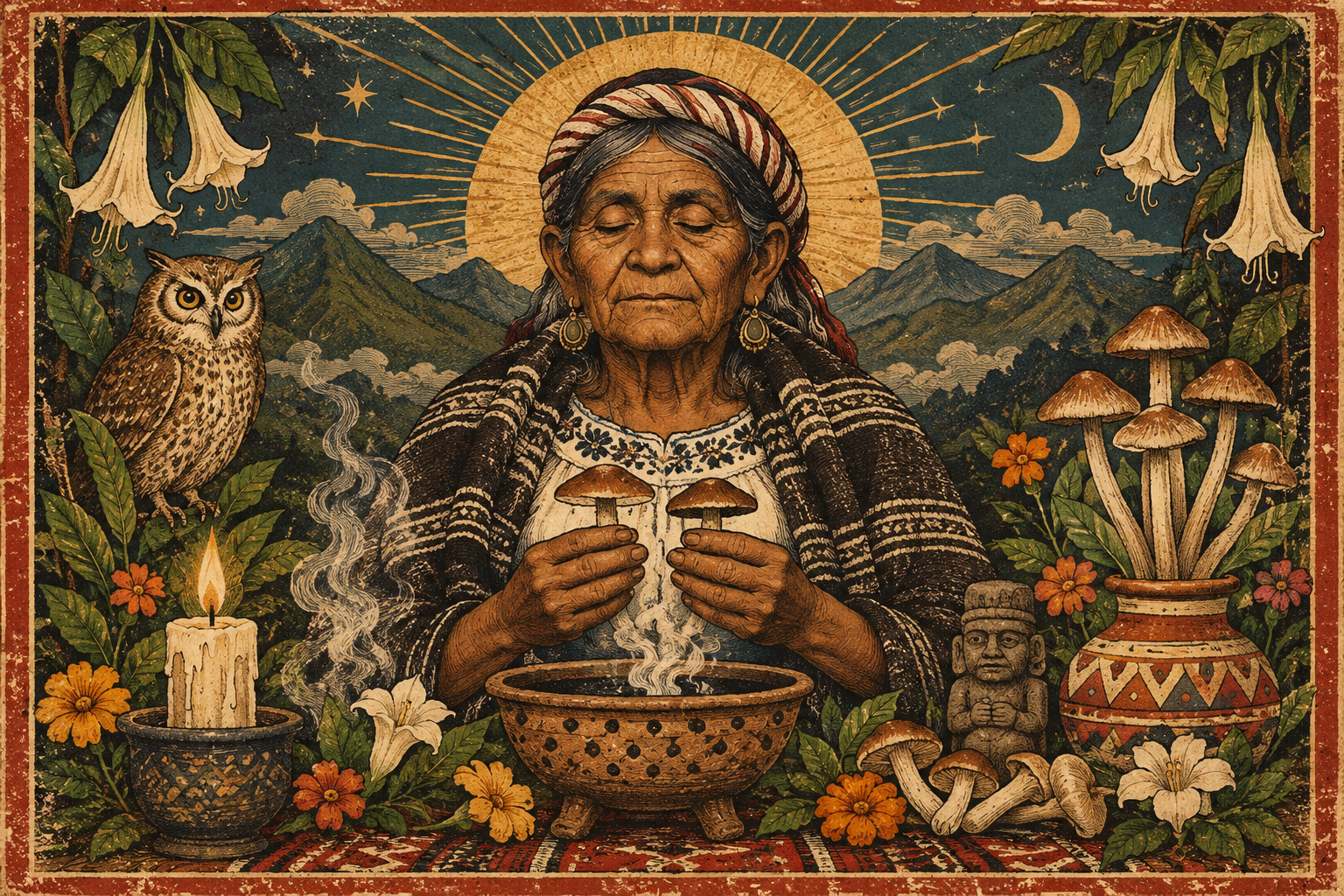
She was an Indigenous healer living in a small village in the mountains of Mexico, far from the eyes of the world. For decades, she used sacred mushrooms to heal the sick and communicate with the spiritual realm. Then an American banker arrived at her door, and the world followed. The story of María Sabina is one of faith, healing, psychedelia, and the heavy price of a collision between cultures.
The woman from the mountains
High in the Sierra Mazateca of Oaxaca, Mexico, lies the town of Huautla de Jiménez. For generations, the region was home to a spiritual tradition centered around psychoactive mushrooms. For the Mazatec people, these mushrooms were not recreational drugs or a means of seeking extraordinary experiences. They belonged to a larger world of faith, healing, and communication with unseen forces. It was here, in 1894, that María Sabina was born. She would eventually become one of the most influential figures in the modern history of psychedelia, despite never asking for such a role.
Sabina grew up in poverty. Her father died when she was very young, and she began working as a child. She received little formal education and never learned to read or write. But the world in which she grew up possessed another kind of knowledge, one passed down through generations in stories, songs, rituals, and experience.
According to her own account, she first encountered the mushrooms as a child. Later in life, she became a spiritual healer, one of the women the Mazatec called a sabia, a wise woman, someone believed to possess a special kind of knowledge. Sabina believed the mushrooms allowed her to see what ordinary human eyes could not.
The holy children
María Sabina did not call them “magic mushrooms.” She referred to them as Niños Santos, the Holy Children. The mushrooms, which contain the psychoactive compound psilocybin, were sacred beings to her. Through them, she believed it was possible to receive answers, diagnose illness, find missing people, and communicate with the spiritual world.
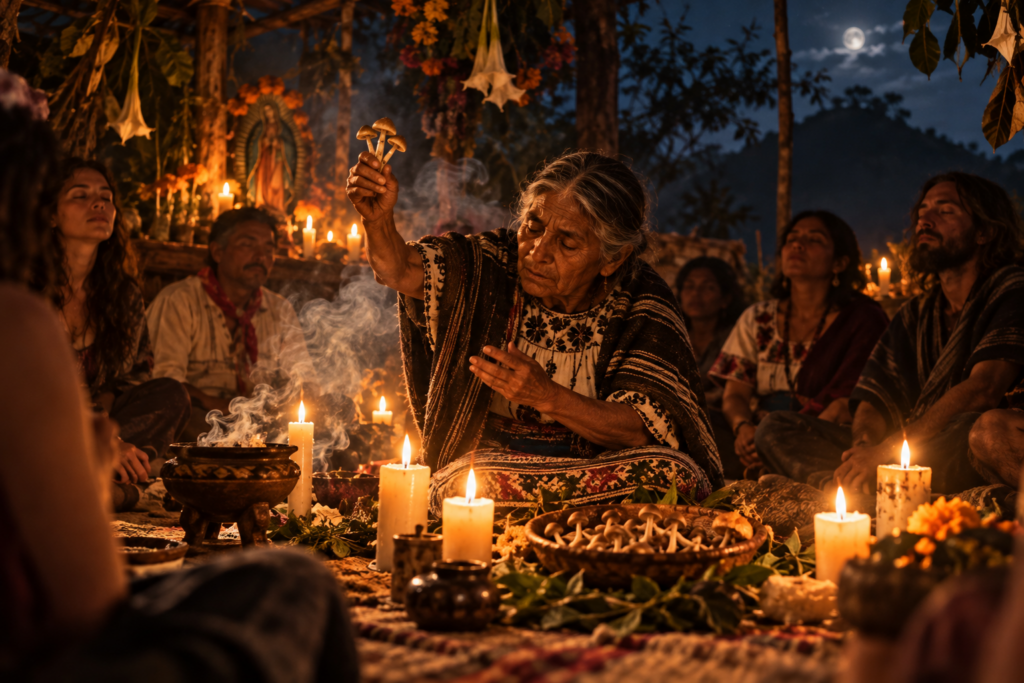
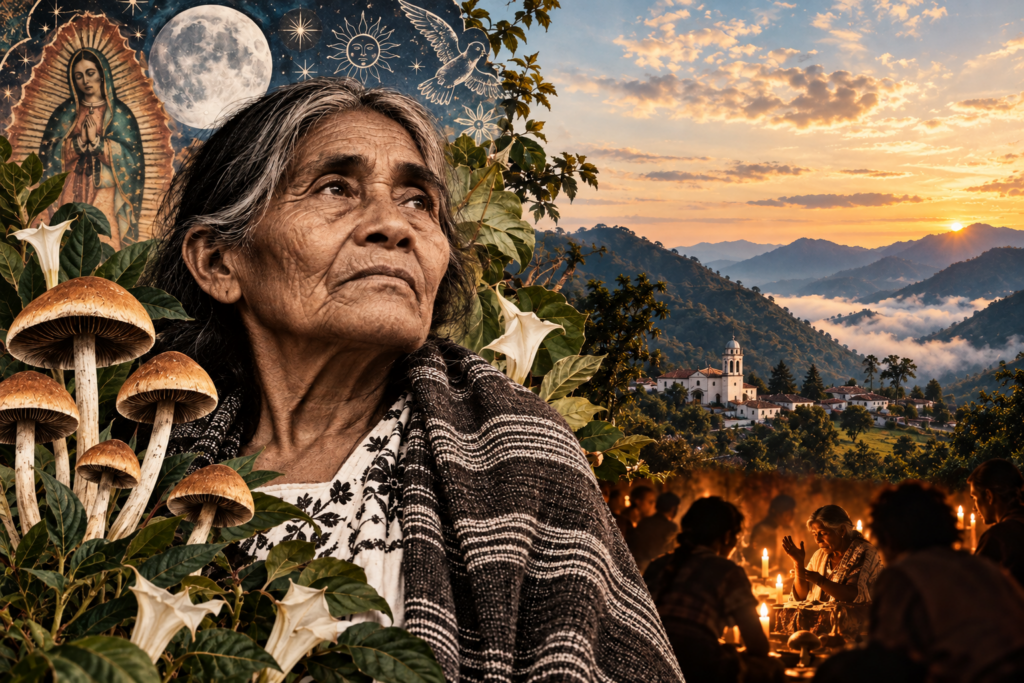
The ceremonies she conducted were known as veladas. These healing rituals were usually held at night, in darkness, and could last for many hours. During a velada, Sabina would sing, pray, speak in hypnotic rhythms, clap her hands, and use repetitive movements and sounds. Participants would eat the mushrooms, but the purpose was not to embark on a personal psychedelic journey. The purpose was healing. Sabina’s spiritual world combined ancient Mazatec traditions with Christian imagery. Jesus, the Virgin Mary, Catholic saints, and the sacred mushrooms existed side by side, without contradiction.
For her, healing did not come from the chemical substance in the mushrooms alone. It was inseparable from intention, words, belief, and ritual.
The woman the mushrooms spoke through
One of the most fascinating aspects of María Sabina’s life was her poetry. Her ceremonies included long passages of improvised song in which she described herself through images of animals, natural forces, spiritual beings, and sacred figures.
In one of her recorded chants, she sings:
“I am a woman who is a shooting star.”
“I am a woman who is a trumpet.”
“I am a woman who is a drum.”
“I am a woman who is a book.”
For Sabina, these words were not poetry in the conventional sense. She believed the mushrooms themselves were speaking through her and that she was simply the vessel carrying their words. Yet her chants were remarkable as poetry. Their repetition, rhythm, imagery, and constant movement between different identities created a language that was both hypnotic and deeply evocative.
Over the years, some of her ceremonies were recorded, and her chants were translated into Spanish and English. In this way, a woman who could neither read nor write eventually came to be recognized as an important voice in oral poetry and Indigenous culture.
The banker who came looking for mushrooms
In 1955, an unusual visitor arrived in Huautla de Jiménez: R. Gordon Wasson, an American banker with a lifelong fascination with mushrooms and their role in human culture.
Wasson and his wife, Valentina, had spent years researching mushroom traditions around the world. They were particularly interested in reports of ceremonial mushroom use in Mexico, a tradition familiar to local communities but almost entirely unknown to the wider Western public. In June 1955, Wasson and photographer Allan Richardson participated in a ceremony led by María Sabina.
The experience had a profound effect on Wasson. He later described elaborate visions, extraordinary architectural forms, and the sensation of entering an entirely different reality. For Sabina, it was another ceremony within her tradition of healing, even if her visitors were unusual. For Wasson, it was a revelation. Two years later, it became clear just how profoundly that encounter would change her life.
The article that changed everything
On May 13, 1957, the American magazine Life published an article by Wasson titled: Seeking the Magic Mushroom The article described his journey to Mexico and his experience during the mushroom ceremony. Accompanied by photographs and illustrations, it introduced millions of American readers to a world they had never encountered before. Wasson used a pseudonym for Sabina in the article, but her identity and the location of her home were revealed elsewhere. The response was enormous.
For many Western readers, it was their first detailed account of a religious ceremony in which mind-altering mushrooms were used as a spiritual tool. The article appeared just as modern scientific interest in psychedelic substances was beginning to grow. In 1958, Swiss chemist Albert Hofmann, who had previously discovered the effects of LSD, isolated and identified psilocybin as the primary psychoactive compound in the mushrooms being studied.
Within a few years, psychedelic mushrooms would become one of the symbols of a cultural revolution. But while the West celebrated its discovery, life in Huautla was beginning to change.
When the hippies came to town
Throughout the 1960s, young Americans and Europeans began making their way to Huautla. They were artists, writers, researchers, musicians, hippies, and spiritual seekers. Some arrived with a genuine interest in Mazatec tradition. Others were simply looking for the psychedelic experience they had read about. The small mountain town, which had lived according to its own rhythms for generations, gradually became a destination for psychedelic pilgrimage.
Sabina became famous. People wanted to meet her, sit in her ceremonies, and experience what they imagined to be a doorway into another level of consciousness. Stories began circulating about famous musicians visiting her. Names such as John Lennon, Bob Dylan, and Mick Jagger became attached to the legend, although reliable historical evidence for many of these visits is lacking. But the legend soon became more powerful than the facts.
María Sabina was transformed into an icon of the counterculture, a symbol of spiritual freedom, expanded consciousness, and the search for realities beyond the material world. Yet Sabina herself had never belonged to that culture. She was not a hippie. She was not rebelling against Western society. She did not see mushrooms as a means of recreation, experimentation, or self-discovery. She was a healer.
The price of fame
The attention came at a cost. Many people in Huautla saw the growing stream of outsiders as a threat to their traditions. Ceremonies that had existed for generations within a specific cultural and communal context were suddenly objects of international curiosity. Sabina was blamed for allowing sacred knowledge to become accessible to people who, in the eyes of some members of her community, had no right to it.
She faced hostility and rejection. Her home was damaged and burned, and she also found herself dealing with authorities who increasingly viewed the mushrooms not as sacred medicine, but simply as illegal drugs. Her international fame brought her neither wealth nor security. One of the most painful aspects of Sabina’s story is the gap between the way she was perceived in the West and the reality of her own life.
To young Americans, she became a mysterious woman capable of opening doors to other worlds.
To some of her neighbors, she was the person who had allowed outsiders into the heart of their tradition.
To herself, she remained a woman trying to heal people with the help of sacred mushrooms.
Later in life, Sabina expressed sadness about what had happened to them. She remembered a time when the mushrooms were taken to heal the sick. The foreigners, she said, came looking for God. That distinction says almost everything.
Between healing and self-discovery
María Sabina’s story raises a question that remains remarkably relevant today: what happens when spiritual knowledge belonging to one culture becomes a desirable commodity in another? In her case, the encounter between those worlds was far from equal. The West arrived with cameras, magazines, money, research institutions, and the ability to spread information to millions of people. Sabina brought knowledge preserved over generations, embedded in a system of belief in which mushrooms were inseparable from community, nature, illness, spirituality, and ritual.
Wasson and the researchers who followed him played an important role in bringing psychedelic mushrooms to the world’s attention. But Sabina’s story also demonstrates the possible cost of exposing local traditions when the communities that created them have little control over how those traditions are represented or used. The West embraced the mushrooms. It did not necessarily embrace the world they came from.
The legend
María Sabina died on November 22, 1985, after spending most of her life in the mountains of Oaxaca. By the time of her death, she was known around the world, yet she continued to live in modest circumstances. Today, her face appears on murals, T-shirts, posters, and works of art. She appears in books on psychedelia, histories of the counterculture, and discussions about the therapeutic potential of altered states of consciousness.
In recent years, as scientific interest in psilocybin and psychedelic-assisted therapy has returned, her name has begun to appear once again. But there is something important to remember. María Sabina did not discover psychedelic mushrooms. She belonged to a tradition that had existed long before her. Nor did she set out to lead a cultural revolution.
She simply opened her door to a stranger from within a world where mushrooms were sacred, words could heal, and knowledge was woven into life itself. The stranger returned home and told the world what he had seen. The world followed him back. And María Sabina remained in the mountains, with her Holy Children, in a world that would never be quite the same again.