
Magic Mushrooms vs. Antidepressants: What the Evidence Actually Shows
When someone is living with depression, the question “what will actually help me” isn’t abstract. It’s about their life. In recent years, psilocybin – the active compound in “magic mushrooms” – has become the rising star of mental health treatment, promising fast, profound change. But how does it really stack up against the treatment most people already know: antidepressants? A meta-analysis published in March 2026 in JAMA Psychiatry by researchers Williams, Barnett, and Szigeti set out to answer that seriously.
The headline finding: less dramatic than it sounds
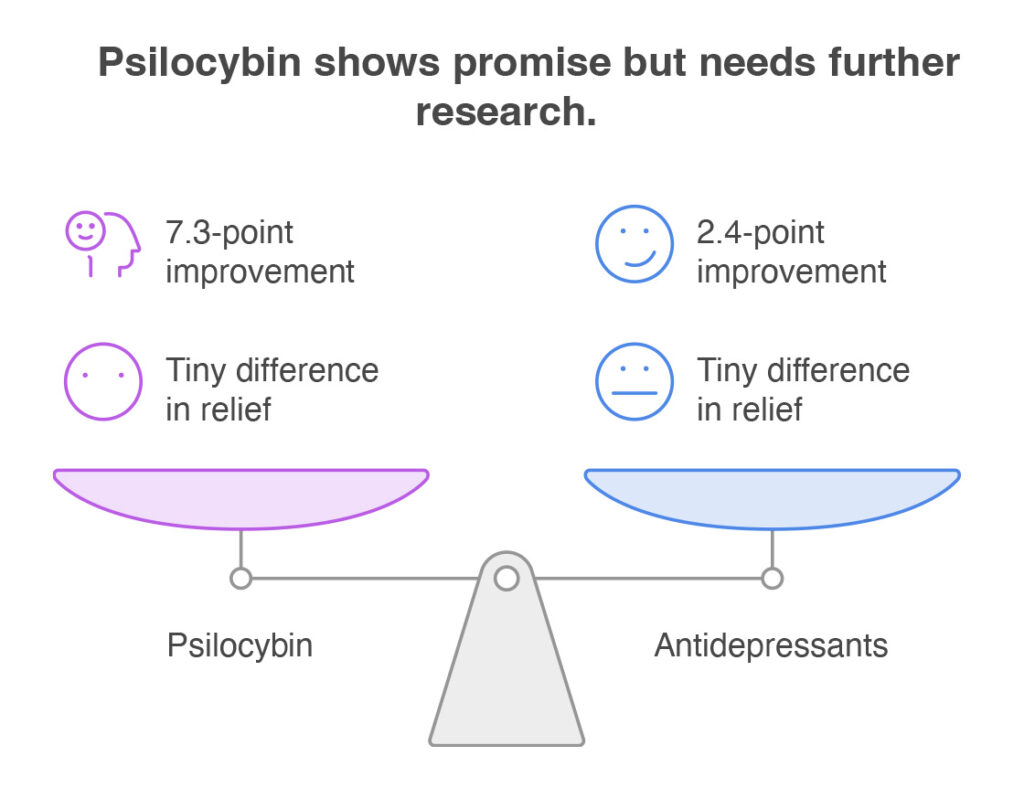
When psilocybin is compared to antidepressants under open-label conditions (meaning both sides know what they’re getting), the difference is tiny: just 0.3 points on the standard depression scale (HAM-D), well below the roughly 3-point threshold considered clinically meaningful. In plain terms, when the two approaches are tested under similar conditions, there’s no real difference in how much relief they provide.
Against placebo, psilocybin showed a 7.3-point improvement, compared to 2.4 points for antidepressants. Those numbers made it look like psilocybin was winning by a landslide. But there’s an important twist.
The problem that complicates everything: everyone knows what they got
Psilocybin trials can almost never be truly double-blind. People who receive it almost always know it: 90 to 95 percent of participants correctly guess what they were given, compared to just 63 percent in antidepressant trials. And that changes everything. Participants in psilocybin trials go through intensive psychological preparation for an experience described as life-changing. Anyone who discovers they got the placebo experiences real disappointment, a kind of reverse placebo effect that drags down the control group’s results. According to the researchers, roughly half of psilocybin’s apparent edge comes from this effect, not from superior pharmacology.
What treatment actually looks like
The scope of treatment differs sharply. Antidepressants require daily medication for at least eight weeks, often much longer. Psilocybin is given in just one to three supervised sessions over three to four weeks.
The side effects differ in kind, too. Antidepressants are linked to chronic effects like sexual dysfunction, weight gain, and emotional numbness. Psilocybin mainly causes temporary effects – headache, nausea – with no evidence of chronic side effects and similar dropout rates between the groups.
What we still don’t know
There are some important caveats. Psilocybin trials tend to enroll a narrow population: participants without co-occurring conditions like anxiety or substance use, and largely from relatively affluent, socioeconomically advantaged backgrounds. How the treatment works across more diverse cultural and economic backgrounds, and for people carrying histories of trauma, remains an open question.
There’s also real disagreement among researchers about what should even be measured. Some, including Robin Carhart-Harris of Imperial College London, argue that secondary outcomes – like the sense of well-being and connectedness tracked six months after the original psilocybin-versus-escitalopram trial – do favor psilocybin, and that it’s unfair to focus on just one measure.
So which is better?
The careful answer: psilocybin isn’t inferior to antidepressants, but it hasn’t been proven superior either when it comes to easing core symptoms. Both approaches work, each with its own costs and benefits — time versus exposure, a daily routine versus a one-time experience. For people with treatment-resistant depression, roughly 55 percent of patients, psilocybin may offer new hope. But broader research, across more diverse populations, is still needed before any final conclusions can be drawn.